


Bugs in Birds Hill

Bugs in Birds Hill

Although I am a botanist by training, over the last six years I developed a real passion for insects. It all started when I planted a wildflower garden in my back yard. I would sit on my patio after work, drink iced tea and watch an amazing variety of insects visit my flowers. When I started working here at the Museum I decided to pursue this interest by studying the pollinating insects in one of Manitoba’s rarest ecosystems, the tall-grass prairie.

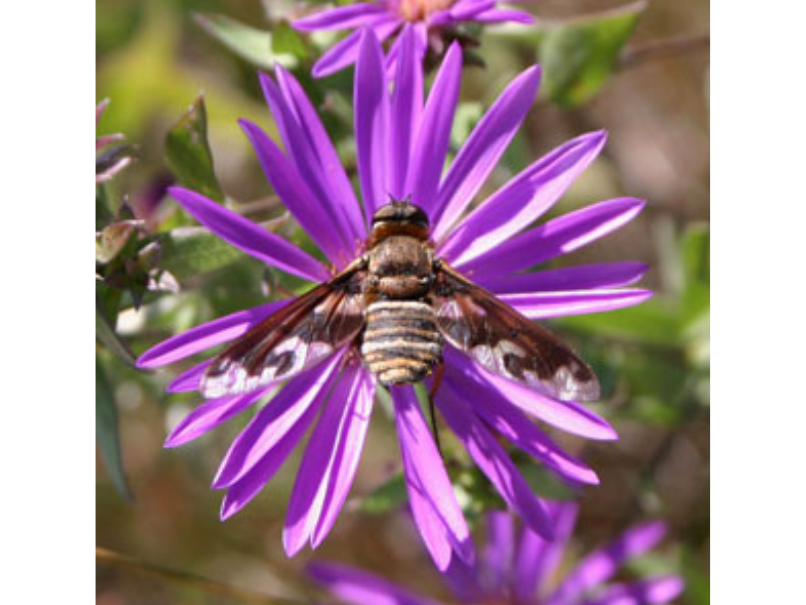
For the last two weeks I’ve been sitting quietly on a stool in various places in Birds Hill Provincial Park to record the visitation sequences of pollinating insects. My favourite fly (I don’t imagine too many people can say they have one of those) is a little bee fly called Anastoechus. They look like tiny little pussy willows with wings and I think they’re adorable! They feed on the nectar of Western Silvery Aster and other flowers with their long proboscises, and parasitize grasshoppers by laying their own eggs on grasshopper eggs. The bee fly larvae then hatch and eat the grasshopper larvae. Cool! Gross too!
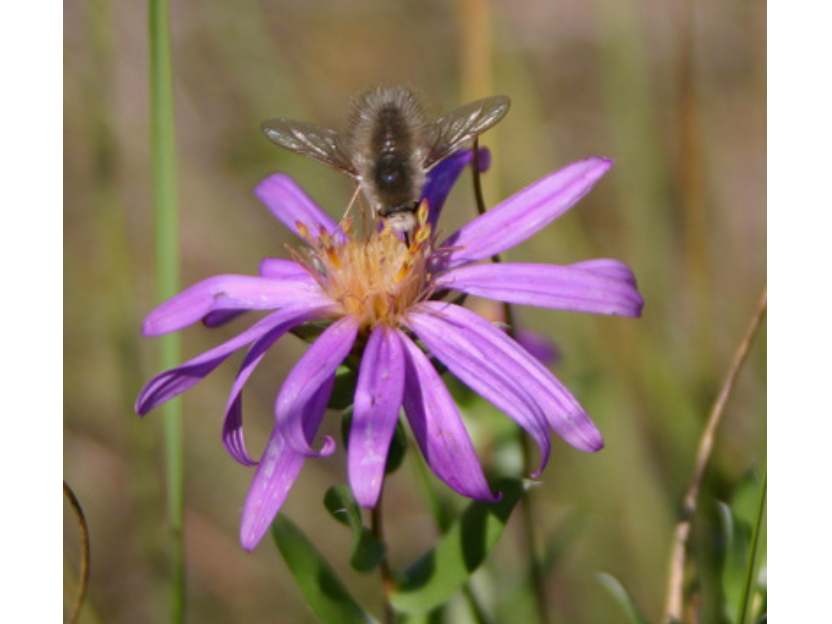
Close-up on a flower with long purple petals with an insect perched near the yellow centre.

Bee fly on Western Silvery Aster.

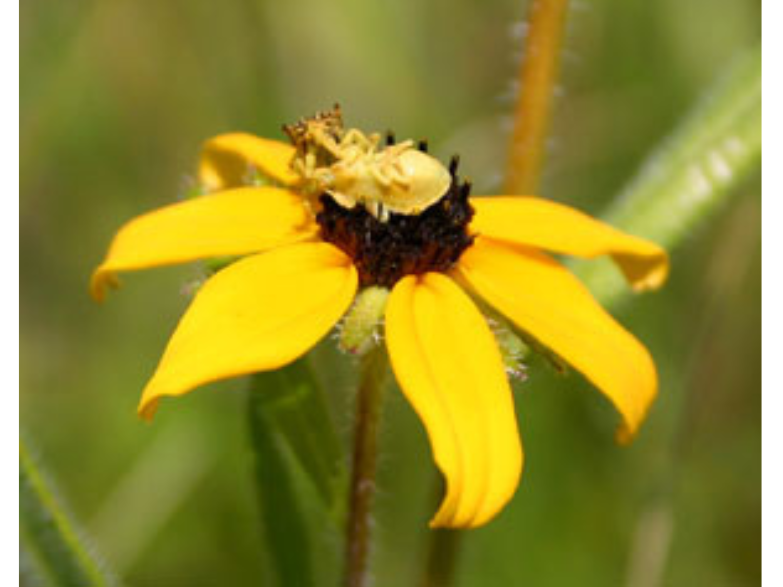
Close-up on a flower with yellow petals and a dark centre. A pale yellow insect sits on the centre.

Ambush bug canabalizing another.

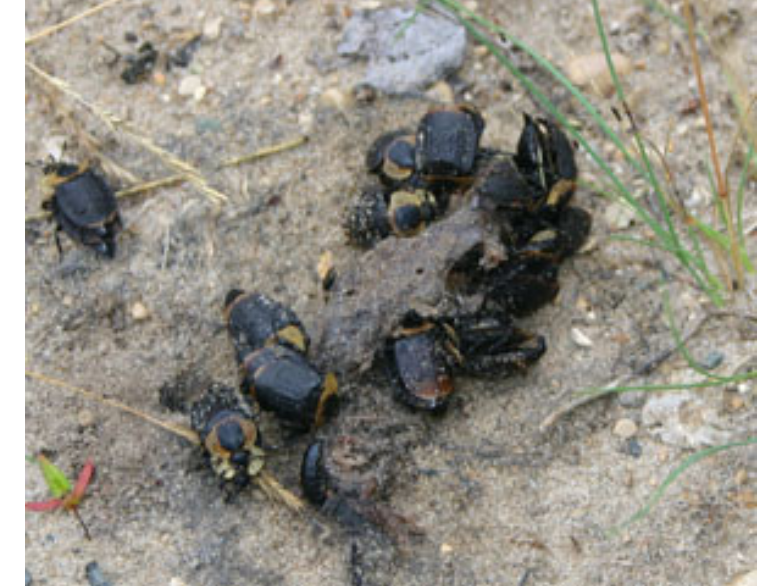
A small group of beetles gathered on a piece of dung.

I’m also rather fond of (or more accurately fascinated and repulsed at the same time) by ambush bugs (Phymata spp.). I remember the first time I saw one. I was recording the visitation sequence of a bee when all of a sudden it stopped moving. After a minute went by I moved closer to see what had happened to it. A strange bug had captured and appeared to be eating it. I contacted Rob Roughley at the University of Manitoba (sadly, he passed away in 2009), to see if he knew what this insect was. Being the fount of entomological knowledge that he was, he immediately identified it for me. Turns out that ambush bugs produce a paralytic poison to subdue their prey very rapidly. Then they inject digestive enzymes into the exoskeleton of the insect to liquefy the goo inside so they can suck it out. Sometimes they share their meals with each other and sometimes if they’re really hungry, they cannibalize each other. Cool! Gross too!


Image: American carrion beetles on, you guessed it, carrion!

Rob also identified a strange beetle that I had seen on prairie roses. I was doing field work at Living Prairie Museum when I observed male beetles chewing off all the stamens of rose flowers, which I thought was a bit odd. Later on I saw beetles mating on the emasculated flowers. Rob told me it was a “rose-emasculating beetle” (a pretty fitting name), and that the males trimmed the stamens to make a little “love nest” to attract females. So I guess it’s not just humans that use roses to attract mates.

Much less attractive scents -from our point of view at least- get other beetle species in the mood for love, namely the smell of rotting meat. I was hiking along a trail in the park to get to some of my research plots when I saw a congregation of about 20 mating beetles crawling over what looked like part of a carcass. I hypothesized that they were probably interested in laying eggs in or near the meat. A bit of research led me to conclude that they were likely American Carrion Beetles (Necrophila americana). Turns out that if you’re an American Carrion Beetle, carcasses are the equivalent of night clubs; males hang out there and wait for attractive females to show up. Then when the females arrive, they pounce on them so they can’t meet any other guys! Pretty clever!
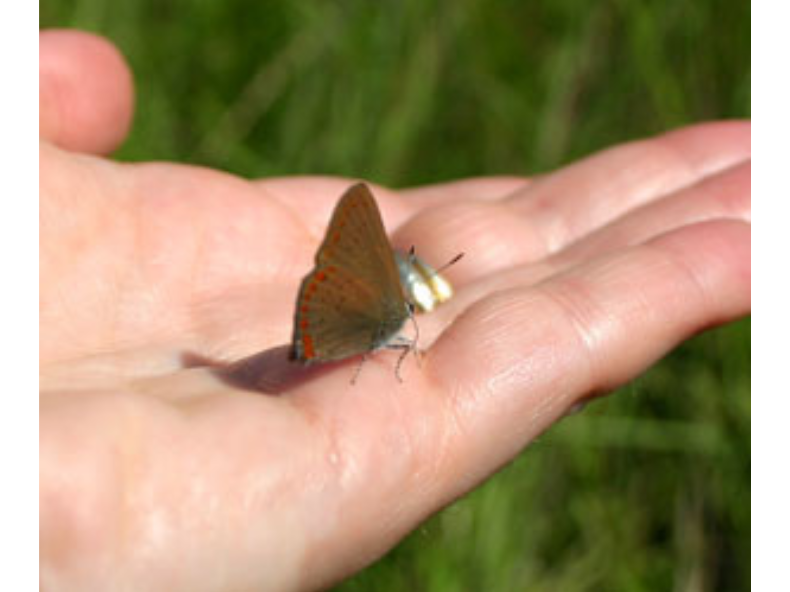
A small brown butterfly perched on the palm of an extended hand.

A Coral Hairstreak butterfly lapping up the salty sweat on my hand.
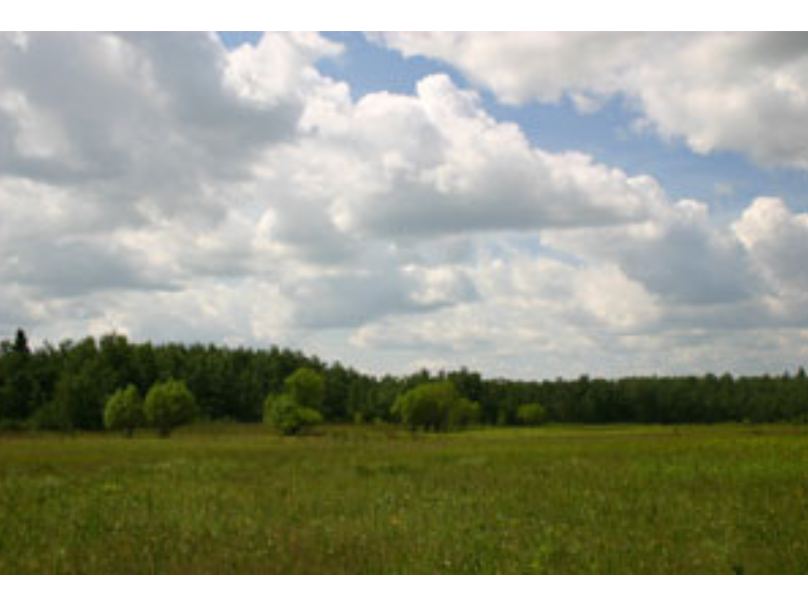
Expanse of grass with dense trees in the background, below a blue sky with many fluffy, white clouds.

A lovely day in Birds Hill Provincial Park.

This week I became a willing donor of bodily fluids to one of the local Hairstreak (Satyrium) butterflies. It landed on my hand while I was monitoring one of my plots and proceeded to lap up my sweat (given the heat this week there was no lack of it), presumably to get the salts. It licked my hand for about 30 minutes and even continued to do so while I walked to my car. I’ve also, in times past, donated salt to the local sweat bees. For this reason I usually pause before slapping something on my limbs lest I accidentally squish a friendly butterfly or bee instead of a mosquito (I’m not too keen on donating blood since I get horrible itchy welts).

The more I learn about insects through my observations of them, the more fascinated I become. Hopefully some of my fascination has now rubbed off on you. Now get off your computer and go look at some bugs!

Dr. Diana Bizecki Robson

Dr. Diana Bizecki Robson

Curator of Botany

Dr. Bizecki Robson obtained a Master’s Degree in Plant Ecology at the University of Saskatchewan studying rare plants of the mixed grass prairies. After working as an environmental consultant and sessional lecturer…
Meet Dr. Bizecki Robson

“All I know is that I know nothing”

I didn’t really understand this quote by Socrates until I started working on my Master’s degree. I soon discovered that no matter how much I learned, there was always much more TO learn. Although it is fair to say that scientists find answers, it is just as accurate to say that we discover questions.

Research sounds pretty simple. You start by asking an interesting question about how the world works, and then formulate an idea regarding what the answer will be based on your knowledge of the subject and a literature review (a hypothesis in scientific speak). If you’ve designed your study well, you should soon have an answer to your question. However, the answer you get usually creates additional questions that you hadn’t even thought to ask. Questions that need to be answered before you can publish your research, and send you to “back to the ol’ drawing board” to write yet another grant proposal. Science is kind of like cutting off the head of the mythical hydra: more heads (questions) keep popping up to replace the ones you’ve already dealt with. Ultimately this isn’t a bad thing as it ensures that good science gets done, but sometimes it can make you feel like you’re running on an unstoppable treadmill.

Close-up on a bee fly resting in the centre of a flower with purple petals.

A good example of this is my recent research on Western Silvery Aster. This nationally rare plant can be found in nearby Birds Hill Provincial Park. I discovered that very little was known about its pollination ecology, my personal area of research interest, so I embarked on a plan to identify its pollinators in the hopes of providing useful information to help government scientists prepare their recovery plan.

While conducting the pollination study, I observed that flower production was higher in some areas of the park than others. I began to wonder whether this difference was due to heavier competition with other species for soil resources such as nitrogen. The following year I attempted to answer this question by establishing some study-plots to determine the impact of fertilization on flower production. Although there was a slight increase in flower production in fertilized plots, the impact was not as high as I thought it would be, which suggests that there is some other limiting factor at work, perhaps water or phosphorus. I have yet to design a study to answer that question because I also wanted to know if other plants facilitate pollination of Western Silvery Aster by providing nectar to its pollinators earlier in the year. Next week I will begin conducting these pollination surveys so if you’re out in Birds Hill Park and see someone sitting on a stool in the middle of the prairie with a white hat and butterfly net-that’s me!


Image: A bee fly (Exoprosopa sp.) on a Western Silvery Aster flower.

One of things that can greatly affect the interpretation of data is the weather. One manuscript of mine was rejected because the reviewers deemed that only one year of data was insufficient to make any generalizations about pollinator communities. Collecting another year’s worth of data allowed me to demonstrate that insect and plant communities can vary substantially in terms of their abundance from year to year due to differences in the weather. I was fortunate to be able to compare a relatively cool summer (2004) to one that was more typical (2005). In general, it seems to take at least two field seasons (and ideally more) to detect meaningful patterns in nature due to variability in the weather. I’ve learned that a scientist has to build flexibility and redundancy into his/her research plans to obtain at least some good data and take advantage of serendipitous observations.

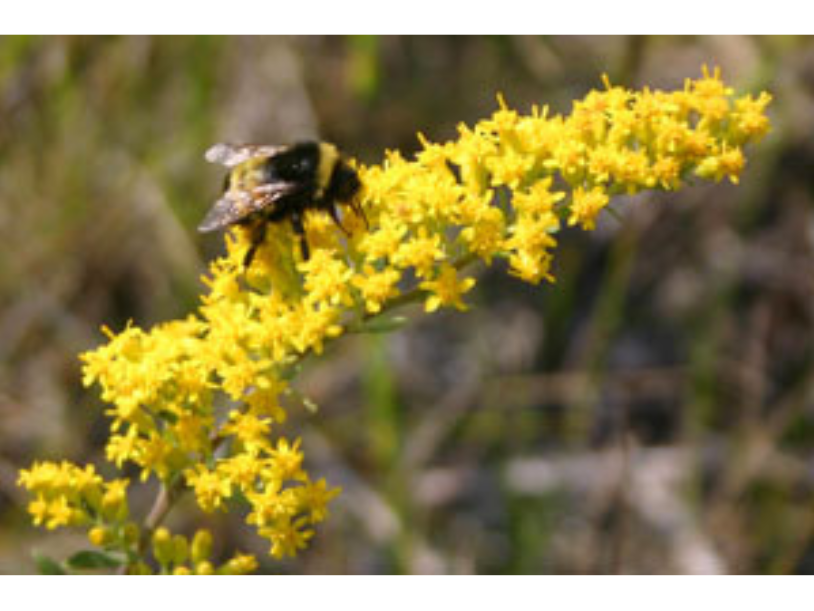
A bumblebee on a long extended yellow flower.

Despite the problems I’ve encountered, my efforts have met with success.  The results of my pollination research on Western Silvery Aster, “A comparison of flower-visiting insects to rare Symphyotrichum sericeum and common Solidago nemoralis (Asteraceae)” were published in the scientific journal Botany.  A second article, “Reproductive ecology of the western silvery aster Symphyotrichum sericeum in Canada”, was recently published in the open access journal Endangered Species Research (http://www.int-res.com/articles/esr2010/12/n012p049.pdf).  You can also check out my earlier paper, “The structure of the flower-insect visitor system in tall-grass prairie”,  in the journal Botany.


Image: Bumblebee (Bombus sp.) on Showy Goldenrod.

Dr. Diana Bizecki Robson

Dr. Diana Bizecki Robson

Curator of Botany

Dr. Bizecki Robson obtained a Master’s Degree in Plant Ecology at the University of Saskatchewan studying rare plants of the mixed grass prairies. After working as an environmental consultant and sessional lecturer…
Meet Dr. Bizecki Robson