
Museum receives funding support for database upgrade

The Manitoba Museum uses a collections management database program called Cuadra STAR, licensed from Cuadra Associates, a California software company. The program is used for documenting the Museum’s permanent object collection.

 The collections management work the Collections and Conservation Department does relies heavily on this database program. It is where we record all of our collection transactions, from the time an object is considered for acquisition to when it legally becomes Museum property; through its life here, any use for loan, exhibit, conservation or research. Any information that we have about an object is contained in its STAR database record. There are more than 530,000 records to date.

 Over the past year, The Manitoba Museum received grant funding from both The Winnipeg Foundation and the City of Winnipeg Museums Board to perform a technical upgrade to the program. The project focused on our inventory location system. First, our location descriptions were standardized, following discussion with and input from Curatorial staff. We were fortunate in having a summer student, partially funded by Young Canada Works, to complete the vast majority of work designing, printing and applying new labels in all our collection storage areas. She made almost 5000 labels!

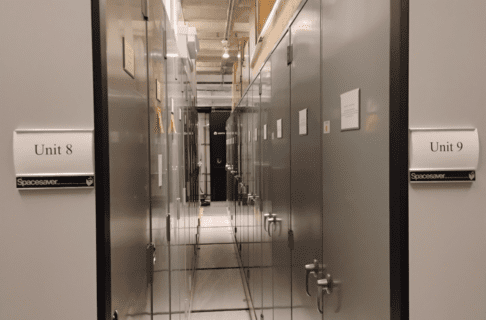
Storage units in our 6th floor collection room


Cabinet with location labelling

 In the meantime, consultation was underway with Cuadra Associates to determine required changes to the database. It took many months for the work to be completed. Collection Database Administrator Betty-Ann Penner liaised  with Cuadra Associates staff to ensure a smooth process and minimize errors. The final product was delivered in March, and now our collection inventory location system is much improved.

 The Museum’s collection database is vitally important to our mission and the work we do. It was a bit nerve-wracking during the upgrade; we had to work through glitches, but it is such a relief to have the improved system. We continue to examine our processes and look for more ways to improve our use of the database program.

 The Manitoba Museum is extremely grateful for, and wishes to acknowledge the support it received from The Winnipeg Foundation Community Grants Program, and the City of Winnipeg Museums Board Special Project Grant Program. Without this funding assistance the work would not have been possible.


Focus on cataloguing: an interesting artefact


Part of a Collections Assistant’s work in the Museum’s History Department is to fully catalogue artefacts which have been acquired for the permanent collections.

This involves assigning a unique museum number to the object, writing a description, explaining how it was used and by whom, and researching how it relates to Manitoba’s history.  When researching artefacts, the Museum has an excellent Reference Library, where staff can check out books related to many historical topics; the internet is also a valuable resource.  The information gathered is entered into an in-house collections management database, and the artefact is also photographed before being placed in a storage room or on exhibit.

One interesting and unusual object in the collection is a 1950s Hedgehog Doll, named Mecki, manufactured by the Steiff company. The doll has a pressed rubber head in the image of a hedgehog, painted eyes and nose, and mohair fabric hair and chest. The jointed body is stuffed with straw, which makes it quite different from other dolls and toys in the collection.

Purchased by the donor in Germany in 1952, this is the father doll in a family of four, the others being Micki (mother), Macki (girl) and Mucki (boy). As Mecki was the only doll from this family to be donated,  the Museum is on the lookout  to find the remaining family members to complete the set.

In 1936, Ferdinand Dichl made a full-length animated film entitled, “The Race between the Hare and the Hedgehog”, using bendable figures. In 1951, Dichl Films sold the copyright to the West German magazine Horzu for the immensely popular characters to be made into a comic strip.

At the same time, the Steiff company bought the rights to make the hedgehog characters into toys. The Steiff company was established by Margarete Steiff and her brother, Fritz, in the late 1800s. They produced a line of toys, including felt or plush animals, teddy bears, gnomes, and Kewpie dolls. The company is now the largest manufacturer of soft toys in Germany, and one of the most recognized brands of toys in the world.  Each of their animal toys has a trademark metal button inside the ear, which is used to distinguish Steiff toys from fakes. The Museum has one other Steiff toy in the history collection, which is a pull-along teddy bear on wheels dating to the early 1900s.  

There are many interesting objects in the collection which have not yet been exhibited, but Collections Assistants attempt to provide as much information as possible for Curators and researchers, so that the history of the objects is documented for future use in exhibits, publications, etc.  Sometimes the research process can be frustrating when there’s a lack of information on the objects, but that’s one of the challenges of cataloguing museum artefacts, which makes the job all the more interesting. –Ann Hindley, Collections Assistant

Mecki, the father hedgehog doll

Preserving Traditional Knowledge and Practices: How does it relate to Museum Conservation?

I recently attended a very interesting conference in Oaxaca, Mexico. It was the 8th North American Textile Conservation Conference. Naturally, the focus was on preservation of textiles.  Although I’m not a textile conservation specialist, I do work on textiles here at the Museum, and the conference offered a chance to visit a different area of Mexico, one less travelled by tourists.


As with most conferences, there were paper presentations, posters, receptions, workshops and tours. The theme I found most interesting was that of preservation of traditional knowledge and techniques. Several papers talked about curatorial research on this subject, in different areas of the world ranging from Romania and Greece to Mexico and a Ukrainian-settled area of Cleveland, Ohio.


The tour I went on also had a focus on traditional knowledge and techniques. We first visited the farm of a local man who is trying to maintain the traditional practice of obtaining cochineal dye from insects that live on nopal cactus. He also collects guano from his ducks to use as a mordant in dyeing.

The cochineal insects are in waxy "coccoons" on the cactus pads

The cochineal insects are in waxy "coccoons" on the cactus pads

They are brushed off the cacti into a tray, and will be dried and crushed to use as a dye

They are brushed off the cacti into a tray, and will be dried and crushed to use as a dye

Next we visited a family of artists. The women are all very skilled weavers, using traditional backstrap looms, while the son is a painter. The women gave us a weaving demonstration, and we were able to buy some of their wares. We then went to the home of another weaver, who is teaching young children the use of the backstrap loom, and who wove all the bags the conference attendees received.

The traditional weavers showed us their technique

The traditional weavers showed us their technique

This local weaver made 130 of these bags for conference participants

This local weaver made 130 of these bags for conference participants

Finally, we went to a town where many families carry on a tradition of making painted woodcarvings. The painting is a more recent variation on a long-known tradition of carving the local copal wood.


A variety of natural dyes are used to paint the wood carvings

A variety of natural dyes are used to paint the wood carvings

The issue of preserving traditional knowledge and practices is being given more and more attention as modernization, wars and other factors reduce or eliminate the practices of century- or millennia-old skills. Museum conservators have access to traditionally-made objects in museums. Their examinations often reveal previously unknown or little-understood details of manufacture. Knowledge of manufacturing techniques is important when treating an object, and such knowledge is critical for producing compatible repair or restoration work. 

The transmission of traditional knowledge is also a cultural practice. It’s important for conservators today to bear in mind cultural context in many aspects of the work we do. Attending this conference reinforced that for me.


Holding it Together

The Canadian Conservation Institute (CCI) is part of the federal Department of Canadian Heritage, created to promote the preservation of Canada’s cultural heritage. Every two to three years, CCI develops and hosts in Ottawa a symposium on a conservation topic.

For a week in October conservator Lisa May attended Symposium 2011 – Adhesives and Consolidants for Conservation: Research and Applications.

Internationally attended, the symposium covered the newest research, techniques and products for a wide range of adhesives and consolidants used in conservation. Papers and posters addressed use of these products on virtually every type of material that conservators encounter.

A dedicated poster session and generous breaks allowed for opportunity to speak to the presenters as well as mingle with the over 200 participants. In addition, one afternoon was dedicated to tours of Ottawa institutions.

The last day of the symposium was at CCI where the paper authors, as well as other conservators and scientists working at CCI, demonstrated their new research, techniques and applications. There were over 30 participants presenting 25 minute demonstrations, with each offered four to five times during the day to accommodate all those in attendance. -Lisa May

The opportunity to attend this symposium has allowed for Lisa to return with new contacts and up-to-date information we will use in conservation treatments. In particular, there are some Natural History specimens awaiting our attention, about which she gleaned pertinent suggestions on materials and techniques. Below are three photos Lisa took during the demonstration day.

Original and oven aged self-adhesive tapes and labels samples

Original and oven aged self-adhesive tapes and labels samples

Repairing a parchment tear with gelatine and goldbeater’s skin

Repairing a parchment tear with gelatine and goldbeater’s skin

Parylene coated newspapers and leaves

Parylene coated newspapers and leaves

New safety lines will allow staff to inspect Nonsuch rigging

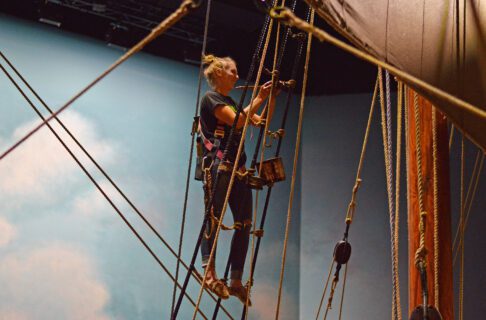
Look up, way up… at the dust on the Nonsuch’s rigging and spars. Museum staff have not been able to climb the ship rigging since Manitoba Workplace Safety and Health regulations were amended several years ago. In order to address the stricter requirements, steel safety cables were installed in the Nonsuch Gallery two years ago. However, they turned out to be less usable than we hoped.

As part of a Conservation Assessment, the Nonsuch was examined by a team including conservation consultants and a ship rigger. One of the recommendations from the assessment was to switch to rope safety lines, for reasons relating to ease of use during climbing. Another recommendation was to add more safety lines, at different spots on the gallery ceiling.

A view of one of the original steel safety lines

A view of one of the original steel safety lines


As a result, last month an engineer was lying on a temporary platform at the Nonsuch Gallery ceiling, lowering a plumb line so the rigger could confirm the correct spots to install additional anchors for the new lines.
Dropping a plumbline from temporary platform at ceiling

Dropping a plumbline from temporary platform at ceiling


The new locations were confirmed, the anchors installed and new synthetic rope safety lines attached. The last task remaining is to do a Risk Assessment and Job Hazard Analysis. After that, we’ll be able to once again climb in the rigging, to do some much-needed cleaning of the lines and sails. Because it’s been several years, we need to plan how best to attack the dust.

The Nonsuch is an unusual thing: a full-sized ship replica, with working rigging, in an indoor setting. There are few other museum ships like it. Although it is an artefact, it is important to keep the rigging at least in working order. Similar to some artefacts in science museums, keeping moving parts static will contribute to their deterioration – ropes will get stiff and develop kinks, making their movement harder and harder, and affecting other parts such as the blocks the lines run through. Keeping the Nonsuch “shipshape” requires regular cleaning and maintenance; soon, one part of that work will be resumed.

From a distance, the safety lines blend in fairly well.

From a distance, the safety lines blend in fairly well.

Close up, they do stand out. I think we'll move this one somewhere less visible.

Close up, they do stand out. I think we'll move this one somewhere less visible.

“Paperwork is my life”:department staff offers Collections Management training for Association of Manitoba Museums

The Manitoba Museum is home to over 2.6 million artefacts and specimens. One role of the Collections and Conservation staff is to maintain records for each item from the time it is offered to the museum, accepted into the collection and then accessed for research and exhibits or loaned to other institutions. While the numbers may be smaller, the same Collections Management practices are used in community museums throughout the province.
Recently, Nancy Anderson, Collections Assistant-Human History, instructed a training course on Collections Management in Shilo, MB. The aim of the course is to give participants the tools to properly manage a museum collection. The course is part of the Association of Manitoba Museum’s Certificate Program in Museum Practice. The thirteen participants represented ten museums throughout the province, including three new museums in Argyle, Brandon and Richer.
In order to be good stewards of our heritage, museums need to be selective in what they accept into their collection. Participants frequently want to know how to fairly represent the various families, businesses and organizations within their community without alienating community supporters or overwhelming the museum’s volunteers and resources. In other words, how do you say no? The answer to that question is to develop a Collections Policy that lets people know what you do collect. A strong policy builds on the museum’s Statement of Purpose (why do we exist?) and describes how and what the museum will collect and how the collection will be used.
Sometimes it seems like the motto for Collections Management could be “Paperwork is my life”. The course stressed the importance of establishing procedures for record keeping for museum collections. Good records insure the museums are meeting their legal and professional responsibilities. The accumulated information about an item enhances its value. Proper catalogue records link that item with its story so that the knowledge can be shared with others.

Participants take on the role of a Collecting Committee at a fictional museum and debate whether a list of objects fits the museum’s Collections Policy.

Participants take on the role of a Collecting Committee at a fictional museum and debate whether a list of objects fits the museum’s Collections Policy.


Following the path of a new artefact through a collections procedures flow chart

Following the path of a new artefact through a collections procedures flow chart

What’s Growing in Storage?

While perusing the collection in storage Roland Sawatzky, Curator of History, discovered something growing…

Artefacts are donated to The Manitoba Museum from all walks of life. Some may still be in their original packaging, never touched, while others may be very well used. Artefacts, regardless of their overall condition, can be very sensitive to the environments in which they are stored. The museum uses dedicated HVAC units to keep the temperature and humidity of the rooms at conservation standards.
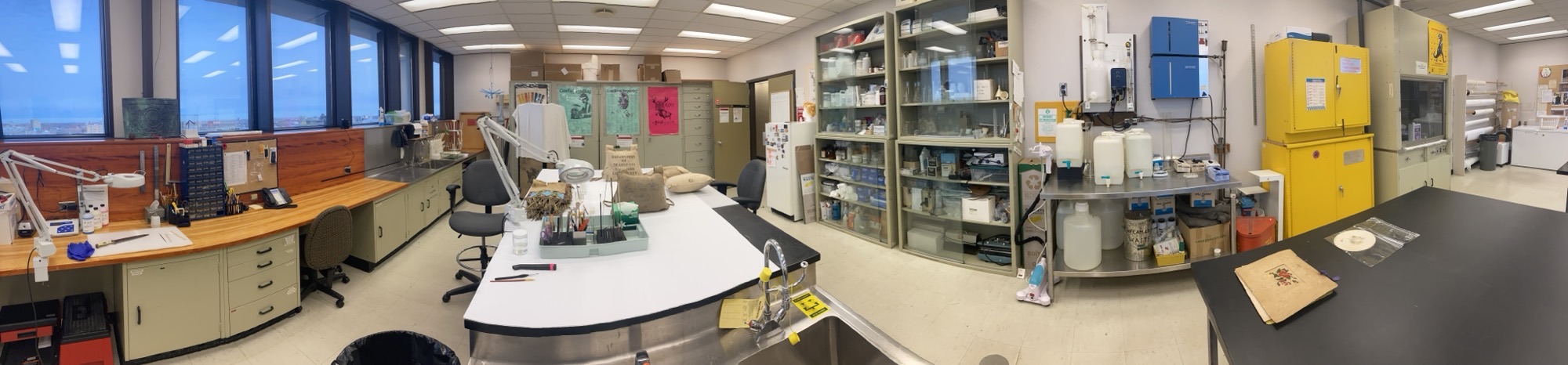
When artefacts arrive at the museum they must acclimatize to their new environment and sometimes this may cause funny things to happen. During Roland’s visit to the storage room he discovered two wooden collar boxes with a strange white substance on them. As he was concerned it was mould growth he brought them immediately to the conservation lab to be assessed.

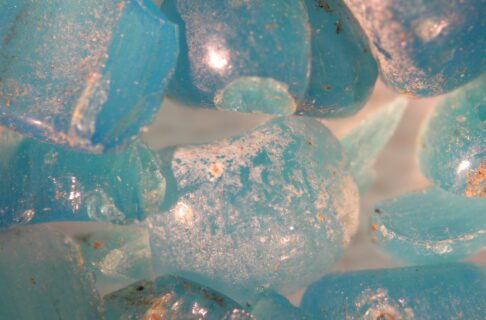
Closeup image of crystals on the wood surface

Closeup image of crystals on the wood surface


Another closeup view. It does look similar to mould, but it's not.

Another closeup view. It does look similar to mould, but it's not.


The substance, found not to be mould, was white coloured crystals growing on the finished areas of the wooden boxes. It appeared to be a component within the finish or varnish which had leached to the surfaces. This most likely occurred while the artefacts adapted to their new environment. In this case, the crystals were cleaned from the objects and luckily caused no harm (i.e.: staining) to their surfaces.
In the darkness of The Manitoba Museum storage rooms unexpected things can occur in our controlled environmental conditions. Fortunately, with eagle-eyed and talented staff we do our best to resolve issues when they arise so the collection is preserved for future generations to enjoy.
-Lisa May, Conservator
The collar boxes and contents after cleaning.

The collar boxes and contents after cleaning.

Hands on: practising emergency response

The 37th annual Canadian Association for Conservation conference was held in Winnipeg in May 2010. Conservator Lisa May attended a two-day pre-conference workshop entitled “Advanced Issues in Emergency Preparedness and Response”. As part of this workshop, Jane Dalley from Heritage Conservation Service (Winnipeg, MB), instructed a hands-on component. Workshop participants experienced how to handle, stabilize and clean water damaged items.

Participants wear protective clothing. In an emergency scenario, there could be dust, mould and water

Participants wear protective clothing. In an emergency scenario, there could be dust, mould and water


A variety of objects made of different materials had to be rescued

A variety of objects made of different materials had to be rescued


The different materials are triaged and separated according to how they will be treated

The different materials are triaged and separated according to how they will be treated


In one room, wet objects are laid to dry on paper towels and clear polyethylene

In one room, wet objects are laid to dry on paper towels and clear polyethylene

In another space, things are drying on a cotton sheet. Notice dye has run on the  print

In another space, things are drying on a cotton sheet. Notice dye has run on the print

Still more objects are laid out on a homemade table made from plumbing pipe

Still more objects are laid out on a homemade table made from plumbing pipe

Paper towels are placed between pages to speed drying

Paper towels are placed between pages to speed drying

A shop vac is useful in a flood or leak

A shop vac is useful in a flood or leak

This was just one part of the workshop. Lectures and discussion to share experiences and questions were an invaluable aspect, but hands-on practice opportunities are rarer. Thanks go to the Canadian Conservation Institute, helped by local organizer Ala Rekrut from the Archives of Manitoba for presenting this professional development opportunity.

Speaking of vacuuming…

Lisa vacuums a bison

Lisa vacuums a bison

A significant part of the conservator’s job is cleaning. At The Manitoba Museum, our numerous open dioramas require regular vacuuming. The larger dioramas require a team of staff including the Conservators, Diorama Artist, Exhibit Assistant and whichever Collections Assistants we can round up. We try to get to every diorama once a year.
Vacuuming through a screen in the Boreal Forest diorama

Vacuuming through a screen in the Boreal Forest diorama


The vacuuming must be done carefully, so parts are not pulled off. That’s why we use screens, and vacuums that are portable and have adjustable suction.
We use household vacuums for most things

We use household vacuums for most things


Brushing dust into the vacuum

Brushing dust into the vacuum


Sometimes, for vacuuming small and/or fragile artefacts or specimens, we put screening over the vacuum nozzle, or use microattachments made for cleaning computers and other electronic equipment.

a piece of window screen can prevent the loss of any parts

a piece of window screen can prevent the loss of any parts


Dirt and dust can be damaging. They may attract insect pests, can be aesthetically disfiguring or obscure important information, and can even cause physical harm by, for example, microscopically tearing fragile threads on an old textile.

The most important thing we remember is to remove as much dirt and dust as possible, without harming the object.

Research Request Leads to Vacuuming

The cariole is lifted off its shelf

The cariole is lifted off its shelf

Recently, researcher Tim Worth requested access to the cariole, a toboggan-like sled, on exhibit in the Hudson’s Bay Company Gallery. Curator Katherine Pettipas agreed it would be a good opportunity to clean the cariole and assess its current condition. The work was scheduled for a Monday, a closed day, to minimize disruption for any visitors. Conservators Ellen Robinson and Lisa May, with assistance from Tim Worth and myself, took the cariole off its shelf, put it on a dolly and took it up to the HBC Lab, where Tim was able to make a thorough examination. He was joined by conservator Rick Lair from Parks Canada, a furniture and wood expert. While the cariole was in the lab, Ellen took the time to give it a thorough vacuuming, inside and out. Collections Assistant Nancy Anderson took numerous photos to enhance the conservation documentation. The interior fabric, a luxurious velvet, had undergone previous conservation treatment by Parks Canada conservator Lorrie Storr. Tim completed his examination and the cariole was returned to its exhibit location at the end of the day. All in all, many people were pleased!
We slid the cariole down on a piece of wood

We slid the cariole down on a piece of wood

We all wanted to take a good look

We all wanted to take a good look

Rick and Tim look at construction details while Ellen vacuums the interior

Rick and Tim look at construction details while Ellen vacuums the interior

The damage has been repaired with a backing fabric

The damage has been repaired with a backing fabric

Bookmark and Share


Copyright 2002 - 2012 The Manitoba Museum